
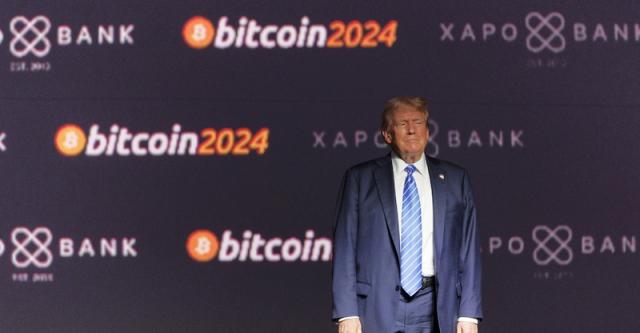
Particularly since the Citizens United ruling, US politics has been awash in corporate and billionaire money, with both parties taking gobs of cash from corporations that have direct interests in government policies. But President Donald Trump has taken corruption to new and breathtakingly bold levels.
“I have never seen such open corruption in any modern government anywhere,” said Harvard professor of government Steven Levitsky (Guardian, 6/17/25).
So, it’s probably not surprising to hear CNN (10/21/26) report that voters are increasingly “concerned about corruption,” ranking it only after the economy and the cost of living as a top concern. In a Gallup poll (9/2/26), a record-high 89% of respondents said they believe corruption is “widespread throughout the government in this country.”
But what might be surprising is that, according to a recent NBC poll (10/18/26), a majority (56%) say corruption “is equally a problem among elected officials in both parties.” (Among those who find it worse in one party or the other, 25% point to Republicans and 17% point to Democrats.)
Why would a majority of the public believe that Republicans and Democrats are equally corrupt? A FAIR study suggests that media play no small role: The US media system has given more coverage to the most prominent allegations of corruption under Biden than to those under Trump.
‘The most corrupt administration in history’
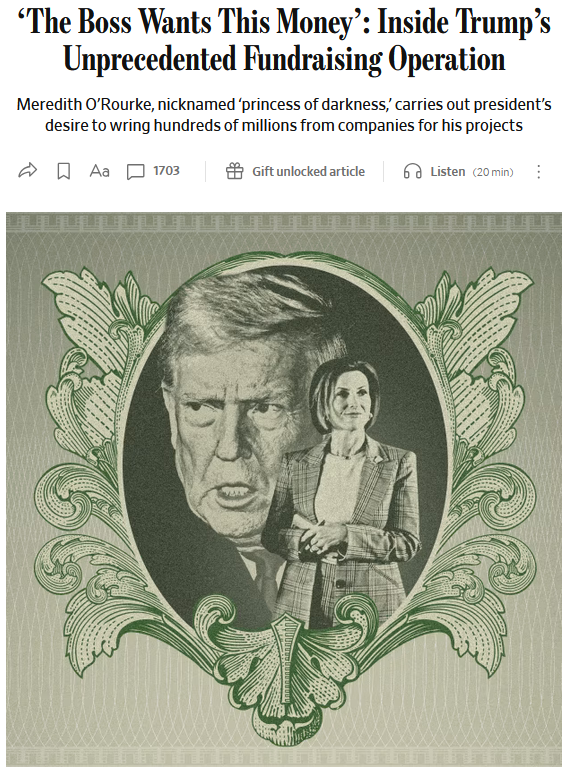
Wall Street Journal (7/30/26): “Trump has been demanding large checks from companies for a range of political and legacy projects…. Some of the corporate donors have later been the beneficiaries of regulatory changes.”
During his first term, Trump refused to divest from his business interests, raking in millions through them from foreign governments and people with interests before his administration. His solicitation of Ukrainian intervention in the 2020 presidential campaign led to his first impeachment trial.
After the GOP-controlled Senate (with Mitt Romney as the sole Republican exception) voted to acquit him—and after the Supreme Court ruling granting the president impunity for virtually anything done in office—Trump unsurprisingly entered his second term with far greater boldness. He essentially operated a pay-to-play administration that engages in regular shakedowns of major corporations and offers pardons to those with political or financial ties to him.
There have been repeated accusations of insider trading under his administration. Trump made $1.4 billion from the cryptocurrency industry in 2025 alone, including $635 million from his $TRUMP memecoin, which was gobbled up by not only true believers but also those seeking political favors. (While Trump profited from fees on trade activity, investors have lost a total of $3.8 billion because of the memecoin’s unsurprising collapse.) In perhaps the most brazen incident of corruption, Trump accepted a Boeing luxury jet worth an estimated $400 million from the Qatari government to use—after spending hundreds of millions of taxpayer dollars on security upgrades—as his presidential plane.
Craig Holman of Public Citizen told FAIR:
The second Trump administration is far more corrupt than Trump’s first administration, and stands out as the most corrupt administration in history. Trump has made no qualms about the fact that he is going to exploit his position as president for self-enrichment. In fact, he has said that he was a fool in his first term for overlooking the opportunities for self-enrichment, given the president’s exemption from the conflict of interest law (18 USC 208).
The corruption is led by Trump, but it’s been enabled by his party since their first impeachment acquittal. In Trump’s second term, the Republican-controlled Congress has refused to investigate any of the corruption scandals, implement stronger ethical standards, or include safeguards in cryptocurrency regulation to prevent Trump (and other political officials) from profiting off it.
Unequal allegations
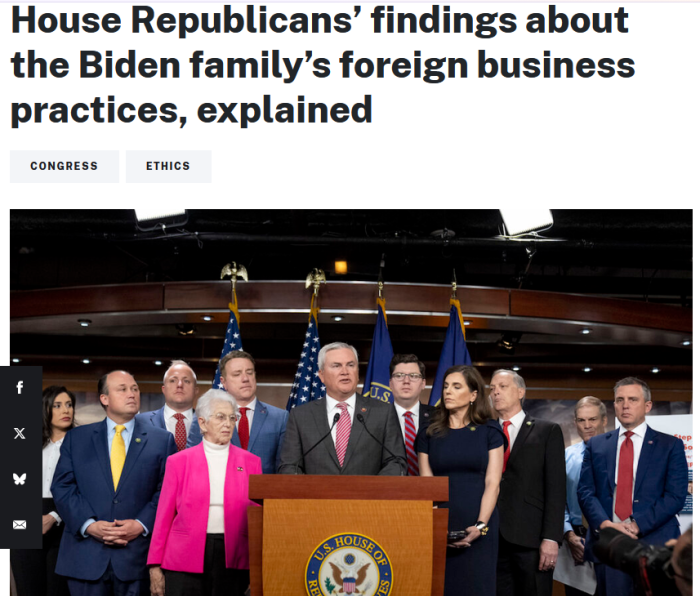
PolitiFact (5/16/23): “Claims that the Oversight Committee implicated President Biden in a bribery or corruption scandal overstate what is supported by evidence.”
During Joe Biden’s election campaigns and presidency, the GOP attempted to paint the former vice president as the pinnacle of corruption. When they took control in 2023, House Republicans launched an oversight committee investigation into the Biden family’s foreign business dealings during his vice presidency. They found that relatives and associates took in a total of $10 million from foreign companies during his tenure, but despite months of investigation, involving interviews and thousands of documents, the committee provided no evidence of Biden’s knowledge or influence. (It did lead to an unsuccessful impeachment inquiry.)
As perhaps the most memorable story in the right’s campaign to make the Biden family known as the “Biden Crime Family,” readers will be familiar with Hunter Biden’s famous laptop, which purportedly contained evidence of corruption on the part of his father. First published by the New York Post (10/14/20) just weeks before the 2020 election, the laptop story was pushed by the right for years and even continues to this day, despite its failure to show any actual evidence of corruption.
So on the one hand we have unsubstantiated stories of Biden family corruption, totaling $10 million in alleged graft, and on the other, we have stories of Trump corruption that total in the billions, some of which will be hard to legally prove Trump’s direct involvement (insider trading) and others in which Trump isn’t even trying to hide his self-enrichment (most of the rest, including the Qatari jet).
If the US had a media ecosystem in which those stories received attention relative to their importance, it wouldn’t even be close: Trump corruption coverage would overwhelm that of Biden.
The laptop and the ‘crime family’
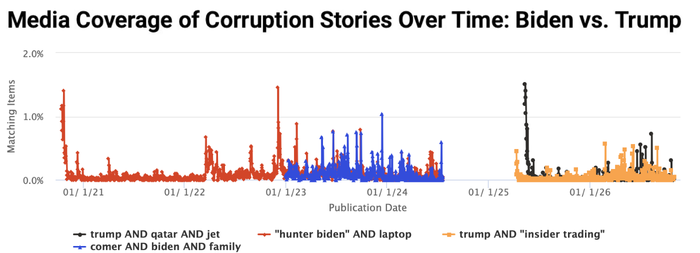
In the distorted media ecosystem we are subjected to, reality is reversed. FAIR searched Media Cloud’s US–National dataset, which indexes 246 online outlets including all major corporate outlets, as well as right-wing sources like Daily Caller and left-wing sources like the Intercept, to compare attention to the two prominent Biden stories and two of the most prominent Trump stories.
When the New York Post (10/14/20) “broke” the Hunter Biden laptop story, it prompted a huge spike of attention that has never fully gone away. Coverage increased in spring of 2022, when outlets like the New York Times (3/16/22) and Washington Post (3/30/22) published pieces that helped revive it; coverage became particularly intense the next year, which saw the GOP inquiry and the Justice Department criminal investigation.
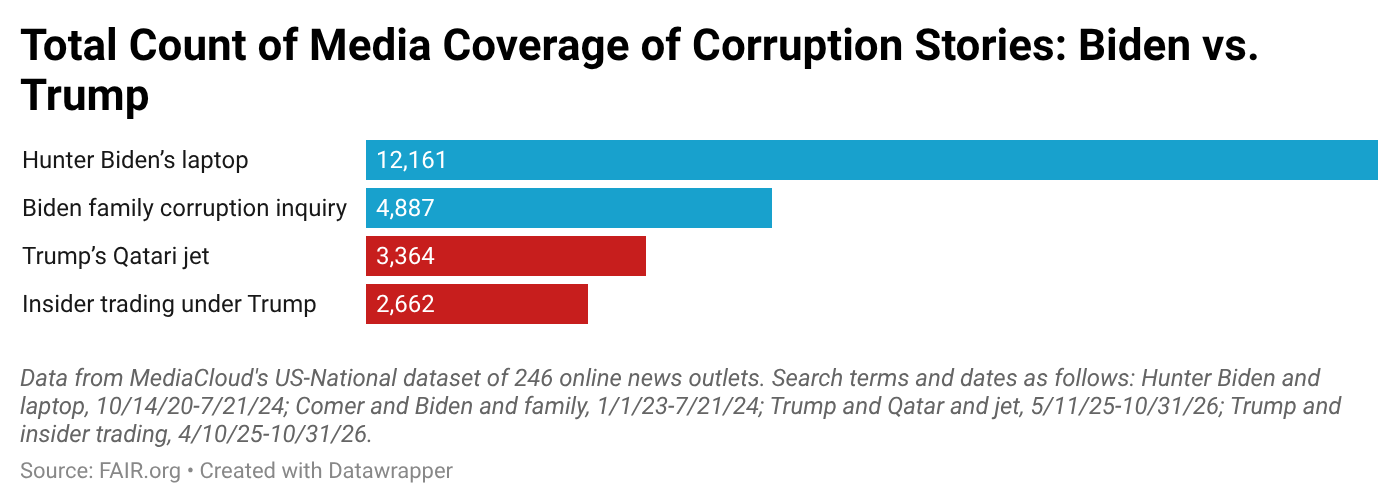
FAIR’s search found a total of 12,161 stories that mentioned “Hunter Biden” and “laptop” from the Post story’s publication through Biden’s withdrawal from the 2024 race (10/14/20-7/21/24). Right-wing outlets led the way, but MediaCloud showed even centrist outlets like the New York Times, Washington Post, USA Today and Newsweek in the top 20 outlets in terms of volume of coverage.
Coverage of the GOP investigation into Biden’s alleged “crime family,” which began in January 2023 and was led by House Oversight Committee chair James Comer (R–Ky.), drew similarly high averages and peaks of coverage, and also largely petered out after Biden’s withdrawal from the presidential race (1/1/23–7/21/24). In that year and a half, MediaCloud recorded 4,887 stories mentioning “Comer” and “Biden” and “family.”
Not all of these stories necessarily accused Biden of corruption; some centrist reports did work to debunk the false right-wing claims. But those big centrist outlets published enough prominent stories with murky headlines like “Biden Faces Conflict of Interest Questions That Are Being Promoted by Trump and Allies” (New York Times, 5/1/19), or explaining that the Hunter Biden case throws a “new wrench” in “the 2024 election” because “Democrats will have a harder time highlighting Trump’s indictments,” to muddy the narrative and legitimize the GOP accusations (see, e.g., CJR, 10/29/19; Press Watch, 8/14/23).
The Qatari jet and insider trading
Compare the quantity of these Biden corruption stories to coverage of the Qatari jet, a story that broke on May 11, 2025, and continued as Trump poured taxpayer dollars into its security upgrades. In the nearly year and a half from the story launch through the end of October 2026, the media produced 3,364 stories on the jet. That means that in approximately the same amount of time, media covered the investigation into Biden family corruption almost 1.5 times more than the Qatari jet. (Note that like the Biden stories, FAIR did not filter out jet stories that did not accuse Trump of corruption.)
Accusations of insider trading in Trump’s second term began in April 2025, when large call options were placed on the market shortly before Trump announced a 90-day pause on tariffs, sending the market soaring. They continued as more such suspicious and lucrative trades happened just before major Trump announcements on Venezuela and Iran, including within Trump’s personal holdings.
Coverage of Trump and insider trading from the first accusations (4/10/25) until the end of October 2026—a month longer than the Qatari jet coverage—has totaled 2,614 stories. The Biden family inquiry, at 4,887, got 1.9 times that amount.
Hunter Biden’s laptop, which dominated news headlines for longer, overwhelmed the Trump stories by far more. It got 4.7 times the coverage of insider trading under Trump and 3.6 times the coverage of Trump’s Qatari jet.
Even measuring them in terms of percentage of all news stories during their respective time periods, the Biden stories got far more coverage, with the family corruption story and the laptop story each averaging .10% of all content, while the Qatar jet averaged .06% and insider trading averaged .04%.
‘So vast as to be a new phenomenon’
New York Times (1/20/26): “All told, Mr. Trump has profited from his return to the presidency by an
amount of money equal to 16,822 times
the median U.S. household income.”
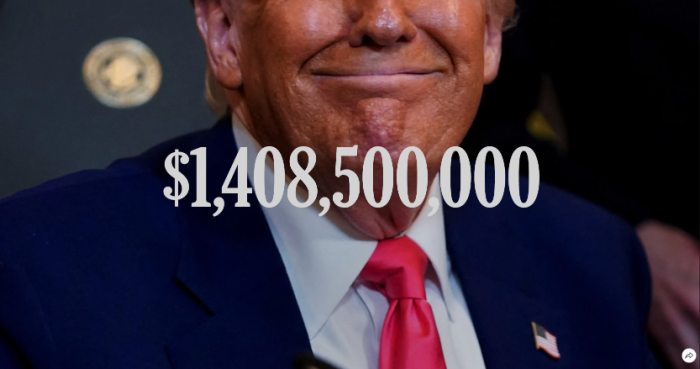
This isn’t to say there’s no coverage of Trump’s corruption that attempts to put it into proper perspective. The New York Times editorial board (1/20/26) ran a lengthy editorial in January that tried to put a dollar amount to Trump’s self-enrichment just in the first year of his second term: $1,408,500,000.
The New Yorker (8/11/25), looking a bit more broadly and including his first term, came up with a conservative total of $4 billion.
Times columnist Jamelle Bouie (4/22/26) wrote:
To say that President Trump is corrupt is to somehow understate the size, scope and magnitude of his corruption.
It is as if you were to describe a modern thermonuclear device as a “bomb.” That is true enough, but it is not quite the truth. It does not capture the nature of the thing in full.
So it goes for Trump’s corruption, which is so vast as to be a new phenomenon in American politics.
Yet, just as media factchecking falters under the sheer number of Trump’s lies, these isolated efforts at contextualization fall increasingly short as Trump’s corruption balloons to nearly unimaginable proportions. That’s especially true as most right-wing media outlets’ interest in corruption would appear to apply only to Democrats.
One of the most important jobs of any media outlet in a democracy is to hold those in power accountable. Democracy doesn’t work if the public doesn’t know or understand what’s happening in their government. As polling shows, people clearly care a great deal about government corruption, but if they have little sense of its mechanics, scale or worst perpetrators, they can’t easily address it. With the midterm elections suggesting a mandate for rooting it out, there’s no more critical time for journalists to step up and shine the line—brightly and consistently—on what our elected and unelected officials are doing to us.
By Julie Hollar