We are in the final week of GOTV, Get Out the Vote. There’s no need to say more; we all know what to do. So today we’ll focus on what comes next, which is less well known: PTV, or Protect the Vote. It covers the period between November 3, 2026, and January 3, 2027.
This period after Election Day deserves as much attention as Election Day itself, especially in the waning days of the fascist cabal in the White House. We know they never lose. Either they win elections. Or they claim they were rigged, and begin work to ‘unrig’ them.
Here’s what STV means for us, starting now: Watch certification timelines. Watch recounts. Watch court challenges. Watch pressure campaigns targeting local election officials and administrators. Watch efforts to transform routine procedures into evidence of conspiracy.
Most importantly, distinguish between legitimate disputes intended to resolve genuine questions and endless disputes intended to manufacture uncertainty. Democracy requires the former. It cannot survive an unlimited supply of the latter.
Citizens should also reject the comforting belief that institutions alone can solve this problem. Laws matter. Courts matter. Procedures matter. But democratic stability ultimately depends on our political culture. No judge can force people to value truth. No statute can compel good faith. No constitutional provision can substitute for a shared commitment to accepting lawful outcomes.
Here’s the real test: The central challenge after November will not be determining who won. The votes will have been counted, the states will certify the results, and the legal disputes will be resolved. The deeper question is whether enough Americans will accept those outcomes once they are known.
Here’s an obvious potential spanner in the works. One obscure federal official, the Clerk of the House, presents the list of the newly elected House members to be sworn in by the new House Speaker they have selected. What happens, for example, if President Donald Trump has the current Speaker, Rep. Michael Johnson (R-LA), fire the current Clerk of the House, and then replaces him with a Trump toady? Or doesn’t replace him at all, since, unlike the Senate, a continuous body, the old House evaporates by Jan. 3, 2027? No one knows. ‘Regular order’ here means it has never happened before and is therefore below our radar.
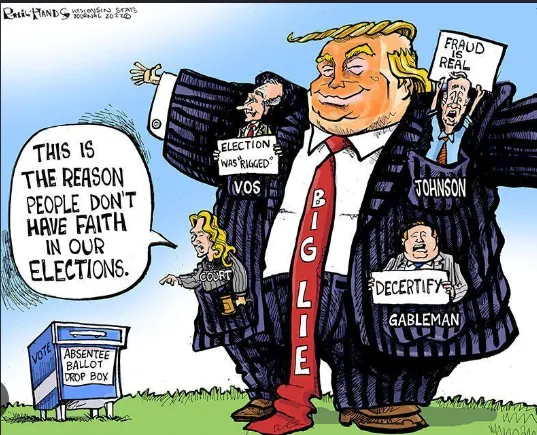
Trump and the MAGA movement have spent years cultivating the opposite impulse. They have taught supporters to view defeat as evidence of fraud, institutions as enemies, and certification as merely the start of another round of grievance. That strategy does not require constitutional collapse to succeed. It requires only enough confusion, enough distrust, and enough repetition to convince millions of people that no outcome counts unless their side prevails.
If the chaos Trump might impose takes over our political life, and Trump’s fevered dream of invoking the Insurrection Act comes into play, what’s next? If he tries to impose martial law, all bets are off.
Democracies do not die only through coups. Sometimes they erode through the systematic destruction of trust. The laws remain, the institutions remain, and elections continue on schedule. What disappears is the shared belief that any outcome is legitimate unless one’s own side prevails.
Trump and the MAGA movement have spent years nurturing precisely that belief. They have taught millions of Americans to regard defeat not as a temporary political setback but as evidence of conspiracy. In doing so, they have transformed losing into something unbearable and compromise into something unforgivable. That is why the real struggle after November may not only concern ballots, certifications, or court filings. It may concern whether enough Americans still believe that democracy requires something more difficult than winning.
It requires the willingness to lose. It means neither leaders nor political parties nor the government itself is the locus of sovereignty. The 9th and 10th Amendments, often referred to as ‘states rights’ amendments, are actually more than that; they display the influence of John Locke on our founders. The locus of our sovereignty is not in government, but in ‘the people’ themselves, stated twice for good measure, and alluded to again in President Abraham Lincoln’s Gettysburg Address.
A republic can survive recounts, lawsuits, and contested elections. What it cannot survive indefinitely is a political movement and its organizations that accept democratic outcomes only when they deliver power to themselves. This will be complicated work in the weeks after Nov. 3, 2026, for progressive lawyers and organizers alike until a new House is duly sworn in. Git’er done.
By Carl Davidson
LeftLinks Newsweekly, Oct 23, 2026 - Go here for the full edition