ProPublica kicked off our day with reporting on Susan Collins and on corruption in Trump’s DOJ. This is the headline: “The FBI Anti-Corruption Squad Was Circling Susan Collins — Until Trump Got in the Way.”
The story begins with Susan Collins back in 2019, trailing in the polls and up for reelection the following year. Then, the head of her super PAC, Scott Reed, met with “three executives from a Hawaiian defense contractor, Navatek” at a Corner Bakery in Washington, D.C. Collins had helped the company get a multimillion-dollar contract with the Navy. Reed asked them to donate $500,000. But there was just one problem. As the report explains, “Government contractors are banned from making political contributions.” And giving a lawmaker something of value, like a $500,000 donation, in exchange for official action is bribery for both the party that makes the donation and the party that receives it. The company wanted to get more contracts in exchange for a donation.
This is eye-popping stuff from a prosecutor’s point of view, and it only gets worse. The CEO was willing to “funnel the donation through a shell company” as long as he was assured Collins would know where the money came from and the company would get more government contracts. What came next was a crime:
“Navatek’s CEO, Martin Kao, sent an initial $150,000 to the Collins super PAC using the shell company. Two months later, he told Navatek executives that Collins committed to getting the company $32 million in naval contracts, according to an internal company email reviewed by ProPublica.” Collins chairs the powerful Senate Appropriations Committee.
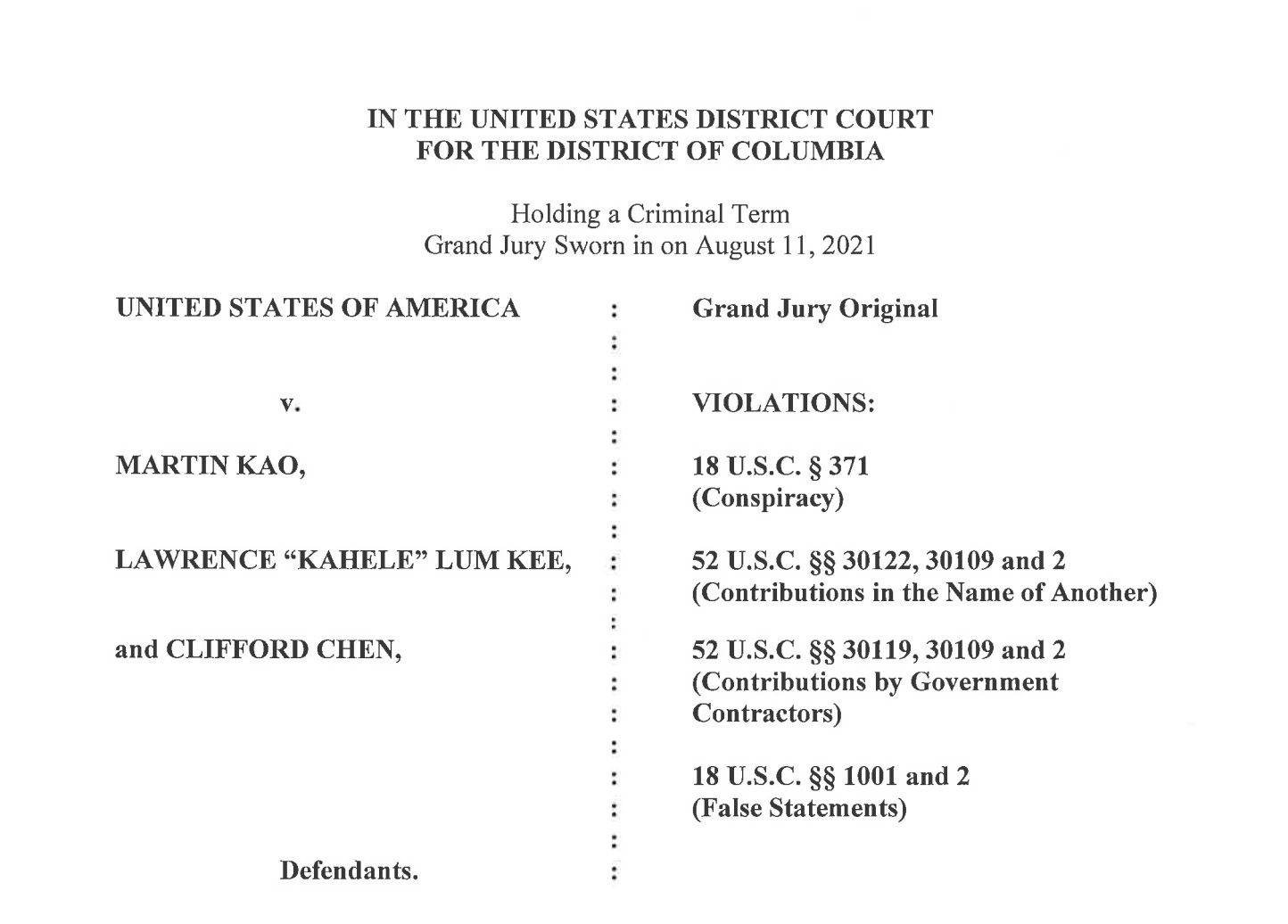
The FBI apparently got wind of what Kao was doing, identified the use of a shell company, and indicted him for making illegal campaign contributions in 2022. Neither Collins nor any of her employees were indicted.
That is not particularly unusual. In a public corruption case, indicting a key private sector participant like Kao can be essential to obtaining his cooperation. And without it, it can be difficult to go further “up the chain” and indict politicians who are involved. That’s how public corruption cases are frequently made: with cooperating codefendants who agree to testify in exchange for a deal. That sounds like what the FBI was working towards here. ProPublica reports that “Facing years in prison, Kao hoped to do less time by revealing the entire scheme,” which was why he agreed to meet with agents and tell all. The information he provided has not been made public, but ProPublica characterizes Kao’s meeting with Reed as “just one episode in a sprawling pay-to-play operation that embroiled some of the most powerful figures in Congress.”
It’s a great case, the kind of case that gives prosecutors the opportunity to clean up public corruption. Kao “gave agents a 50-page document naming dozens of lobbyists, congressional staffers and members of Congress who he said helped him trade cash for contracts. Kao and his close associates had donated nearly $900,000 to dozens of politicians, allowing Navatek to establish operations in half a dozen states with over $40 million a year in government funding.” Worse still, Kao told the agents that “the company’s work for the government was of no real value,” and ProPublica found that their research failed to develop any products the government ordered.
By late 2024, “the agents had enough evidence to pursue a sweeping bribery probe that could ensnare top lawmakers of both political parties.” Then came Trump’s return to office and the much-publicized purge of agents and prosecutors who worked on the cases against him. The two lead FBI agents were casualties of the purge. Corey Amundson, the prosecutor who signed the Kao indictment, resigned from DOJ after being relegated from the Public Integrity Section at DOJ to a “sanctuary city working group.” DOJ disbanded its public corruption unit. The investigation was dead.
Collins’ office responded to ProPublica’s request for comment in an email, writing that Collins “vigorously” denies allegations of bribery and pay-for-play made by Kao.” But it conceded that “the Collins campaign disgorged the illegal contributions that Martin Kao had made without our knowledge.” The email trail reviewed by ProPublica suggests that Collins “pushed the Navy to award specific contracts to Navatek, even though awards are supposed to be competitive.” They quote an email written by someone identified only as a naval officer in February of 2019. He wrote, “I spoke with Sen. Collins office regarding the $8M … The interested company is Navatek.”
It’s hard to assess, from the outside, whether those facts added up to a viable prosecution, although they are substantial. Keep in mind that not everything reporters see is admissible evidence in court. And Kao, the would-be key witness, has a bad reputation, not just related to the conduct that landed him in jail, but also for being untruthful about the details of his personal life. At best, anything he would testify to would need to be corroborated by documentary or other witness testimony. That’s especially true if he was to be the key witness connecting Senator Collins to a bribery scheme and establishing that she was a voluntary, knowing participant. But the reporters detail compelling facts that suggest Collins was a participant, including “out of the blue” contributions made to her just before she put an $8 million pot into the budget that went to Navatek.
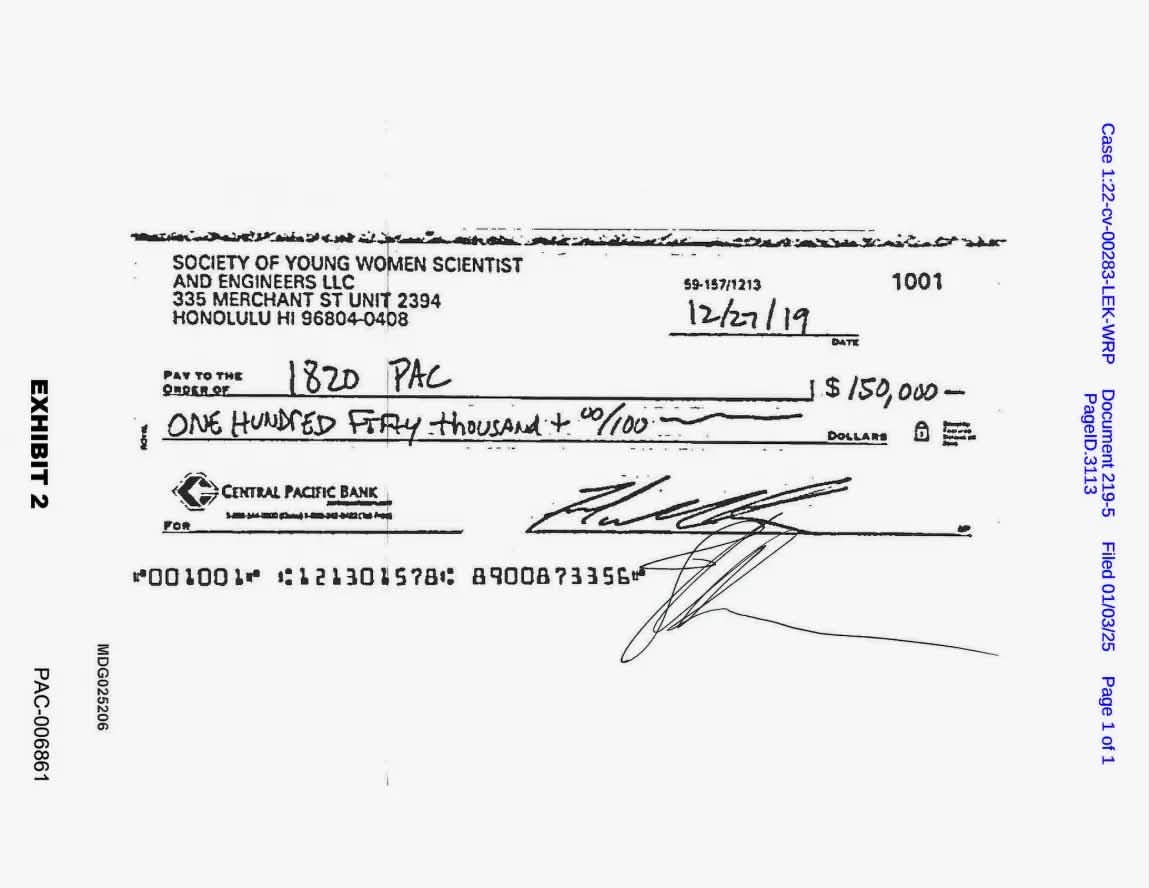
So, what happened after the meeting at the Corner Bakery that ProPublica started out with? The Campaign Legal Center (CLC) started figuring it out. (You may be familiar with them from our Five Questions interview with one of their voting rights lawyers back in 2024. The highly regarded group works to make the political process more accessible and accountable.) They saw that Collins’ PAC got a check for $150,000 from a group called the Society of Young Women Scientist and Engineers. That’s not a typo. There was a missing “s” at the end of Scientist. It looked fishy. They thought the Society might be “a pass-through to hide the identity of a major political donor,” so they filed a complaint with the Federal Election Commission.
A journalist in Hawaii connected the Society to Kao, and on to Navatek. The $150,000 was the money Kao donated after the Corner Bakery meeting, but it was from a Navatek account, and it’s illegal for recipients of government contracts to make political donations. The federal contractor ban has been in place for decades and strictly prohibits these donations to make sure taxpayer-funded contracts aren’t for sale. So, to hide the $150,000 check to Susan Collins’ super PAC, Kao created the Society of Young Women Scientist and Engineers and got caught at it.
After the donation came to light, ProPublica reports that the PAC’s lawyer, Cleta Mitchell (a name you probably remember from her efforts to promote the Big Lie after the 2020 election), was part of a cover-up that was hatched to make the Society look legitimate.
The $150,000 check was included in Kao’s indictment, but it identified the Society by its initials and designated Collins’ PAC as “Political Committee A,” so the story remained hidden until ProPublica’s reporting today. Kao was sentenced to 87 months in prison and got no credit for his attempt to cooperate with the FBI. Susan Collins is in a close reelection fight, with her Democratic opponent, Troy Jackson, up by 3.5 points in the most recent poll. For those of you who are wondering whether the case might get reinvigorated, the statute of limitations runs from the last act committed by a member of a conspiracy, including a cover-up. But Maine voters will have the opportunity to hold Collins accountable if they believe the reporting makes her unfit to continue serving. The ProPublica reporting circulated like wildfire in that state today, where a Senate race that has already had more than its fair share of excitement got a little more.
In other big legal news, Judge Sullivan issued a new order in Katie Phang’s case today, denying Attorney General Todd Blanche’s latest attempt to avoid translating and releasing foreign-language documents. The Court had given Blanche until September 24 to advise it that this work was underway. Instead, Blanche filed a last-minute motion to stay that order.
Judge Sullivan is giving Blanche an opportunity to appeal his decision on an expedited basis, but he had harsh words for the Attorney General. Before filing a motion like this, a party to a lawsuit, including the Attorney General, has a “duty to confer” and is “obligated to consult” with opposing counsel. Blanche didn’t. “He filed the motion on Friday, September 18, 2026, at 8:45 p.m. and requested that the Court rule on the motion by Monday.”
It’s more than just a breach of legal etiquette; it’s additional evidence that this Justice Department thinks it’s above the law. “Because he did not comply with the duty to confer, Defendant provided no notice to Plaintiff that he would be filing a motion for partial stay and requesting a ruling on an expedited basis over the Jewish Yom Kippur holiday,” Judge Sullivan wrote. “It is settled precedent that ‘a litigant’s violation of Local Rule 7(m) [who provides for the duty to confer] is, on its own, reason the deny their motion.’” For a line lawyer at the Department, this level of sloppiness would be an embarrassment. But in this case, with the Attorney General as the defendant, it was deliberate. Todd Blanche and the experienced lawyers available to him know the rules. They chose not to follow them. They tried to argue they didn’t have to, but the Judge called them on it: “Defendant provides no legal authority to support his suggestion that the rule may not ‘technically’ apply here.” He denied Blanche’s motion on that basis.
If that was the only reason for his decision, Blanche might get some traction on appeal. Other judges, as Judge Sullivan notes, will consider a motion even when the party making it fails to confer. But it’s not the only basis on which he rejects Blanche’s request, referencing his earlier decision on the substantive issue: The Epstein Files Transparency Act requires DOJ to turn over these materials. Blanche initially said he didn’t have the resources to do it (which is hardly the case) and essentially blew off his legal obligation. That, of course, is not how this works, and Judge Sullivan called his bluff.
As Katie said in our Substack Live last week, this case is about making the lawyers at the Justice Department follow the law.
And finally, I know many of you listen to Preet Bharara’s and my Insider Podcast. In our new episode, out today, we had an in-depth conversation about the Kennedy Center. And then, Preet took a sharp left turn out of legal analysis and surprised me, as he often does, with the most amazing cultural reference: Ann and Nancy Wilson of Heart playing Stairway to Heaven in a tribute for Led Zeppelin in 2012 at the Kennedy Center. Go listen! It will make your night.
I want Civil Discourse to be a place where everyone can get clear, independent legal analysis of stories, like tonight’s, that matter. Paid subscribers make that happen, not by putting my work behind a paywall, but by making it possible for me to keep doing it and to share it with everyone. If Civil Discourse helps you understand what’s happening and why it matters, becoming a paid subscriber is the best way to support it. And if you’re already a subscriber, thank you. You make this community possible.
We’re in this together,
Joyce