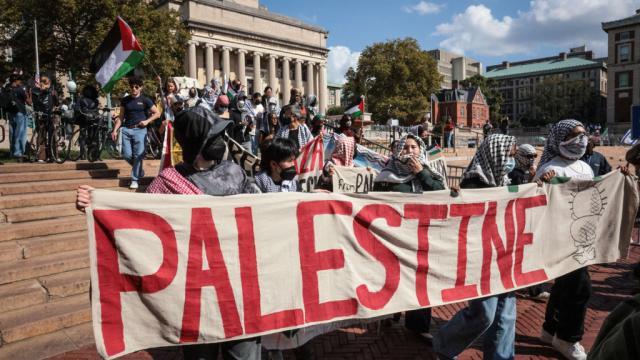
Pro-Palestinian demonstrators march through the Columbia University campus to mark one year of the war between Hamas and Israel in New York City on October 7, 2024. Photo by Kena Betancur/AFP via Getty Images
A group of current and former Palestinian students and faculty at Columbia University filed a lawsuit this week, alleging that the university discriminated against them because of their Palestinian identity and treated them less favorably than other students engaged in political advocacy.
Filed in New York State Supreme Court, the complaint accuses the university of encouraging the mistreatment of Palestinian students by holding “unfair and biased disciplinary hearings” and creating a “hostile and unsafe environment” following Hamas’ Oct. 7 attack on Israel that sparked university-wide protests and tensions on campus. The lawsuit alleges that the university “actively participated in and amplified the racially, ethnically, and politically motivated targeting of Palestinian students, staff, and faculty.”
The case is the latest in a string of legal battles born out of Columbia’s handling of campus protests. In July 2025, the Ivy League university on New York’s Upper West Side agreed to pay $21 million to settle charges by the Equal Employment Opportunity Commission that alleged a hostile work environment for Jewish employees as a part of its federal resolution agreement with the Trump Administration.
In February 2026, the university also settled with a group of Jewish plaintiffs that had alleged the university failed to protect them from antisemitism. As a part of that settlement, Columbia agreed to implement additional programming to address antisemitism.
The new lawsuit alleges that Columbia discriminated against Palestinian students by, among other things, retaining private investigators to surveil students involved in a March 2024 “Resistance 101” teach-in. The event featured Khaled Barakat, whom the U.S. State Department has identified as a leader of the Popular Front for the Liberation of Palestine, which the U.S. has designated a foreign terrorist organization. Following the event, the lawsuit states that six students were suspended from the university and evicted from Columbia housing.
The suit also accuses the university of failing to treat physical assaults of Palestinian students seriously, citing alleged incidents where keffiyehs were forcibly removed from Palestinian students, and an incident where a student sprayed a foul-smelling substance at pro-Palestinian demonstrators in January 2024.
That incident was initially investigated by the New York Police Department as a possible hate crime, with some claiming that the substance was a military grade chemical weapon, but Columbia later announced that the substance was a legal, non-toxic novelty fart spray. The students involved were suspended, but eventually reached a settlement with Columbia after arguing that they had wrongfully portrayed the incident as a chemical attack rather than a “harmless expression of his free speech.”
It also challenges Columbia’s decision to call in New York police to clear protest encampments and arrest demonstrators in the spring of 2024.
Plaintiffs include lecturer and former anthropology student Hadeel Assali, who allegedly canceled her classes so that students could attend Pro-Palestinian protests and who made headlines earlier this year when she gave a talk at the City University of New York’s law school called “The Underground in Gaza.” That lecture, and her dissertation at Columbia overseen by Mahmood Mamdani, father of New York City Mayor Zohran Mamdani, sought to examine “the history and usage of tunnels in Gaza, focusing on land use and social organization in resistance to colonization,” apparently referring to the Hamas tunnel network.
Other plaintiffs include Bahia Munem, a former lecturer at Columbia’s Center for the Study of Ethnicity and Race; Mahdi Sabbagh, a Ph.D. student; Maryam Alwan, who graduated from Columbia in 2025 and was a student leader in the pro-Palestinian movement who was arrested during the encampment protests; and Layla Saliba, who earned a master’s degree in social work from Columbia in 2025.
In April 2025, the Columbia office of Institutional Equity investigated Saliba and Alwan for their role in writing an op-ed in the campus newspaper Columbia Spectator that called on the university to stop admitting Israeli students who had served in the Israel Defense Forces. The university later dropped its investigations into the two activists.
The lawsuit seeks monetary damages under New York City Human Rights Law, which prohibits discrimination or harassment based on race, creed, national origin, immigration status, or citizenship.
Columbia University did not immediately respond to the Forward’s request for comment.