
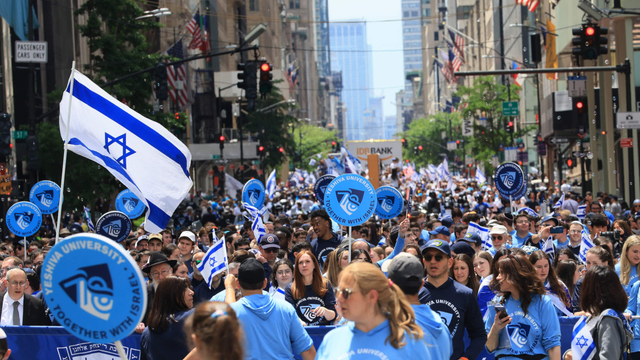
New York City’s annual Israel Day Parade in New York City on May 31, 2026. Photo by Spencer Platt/Getty Images
Mayor Zohran Mamdani made the right decision in skipping the city’s annual Israel Day Parade — because of the specific Israeli officials the parade honored.
American Jews have the right to celebrate Israel’s existence, if they find it to be a meaningful part of their personal Jewish identities. But Mamdani’s specific decision not to march in this specific parade, this year, alongside far-right ministers Bezalel Smotrich, Amichai Chikli and Ofir Sofer, is defensible. Those painting that choice as a sign of antisemitism have a lot of explaining to do about whose company they choose to keep.
Chikli, Israel’s minister of diaspora affairs and combating antisemitism — the man who is supposed to be the voice of diaspora Jews in Israel — has used his platform to spread hatred. He has described LGBTQ+ Pride events as “disgraceful vulgarity”; courted far-right European extremists like Tommy Robinson while parroting their Islamophobic statements; and called antisemitic dog whistles deployed against George Soros by the like of Elon Musk “anything but antisemitism” — while serving as the minister tasked with combating antisemitism.
His behavior has been so outrageous that in 2025, hostage families and Jewish community leaders across Europe signed letters calling him an “inappropriate representative,” citing his statements calling for the expulsion of people from Gaza and southern Lebanon, which they said amounted to support for ethnic cleansing.
Smotrich’s record of inflammatory statements is even more extensive. In 2023, he called for the Palestinian village of Hawara in the West Bank to be destroyed by the state, saying “I think the village of Hawara needs to be wiped out” shortly after a shocking settler attack there that some compared to a pogrom. The United States State Department decried those remarks as “repugnant” and “disgusting.”
Smotrich has since called for Gaza to be emptied of its Palestinian population, and has spearheaded the radical expansion of Israeli settlements in the West Bank, advocating for annexation with the explicit intent of preventing the establishment of a Palestinian state. He himself says the International Criminal Court’s Office of the Prosecutor has reportedly filed a secret arrest warrant application against him for alleged war crimes and crimes against humanity in the occupied West Bank.
At the Sunday parade, Smotrich approvingly told attendees that the event reminded him of the Jerusalem Flag March, an ultra-nationalist procession where participants this year chanted “Death to Arabs” and attacked Palestinian residents.
And Ofir Sofer, Israel’s immigration and absorption minister, has called for changes to Israel’s Law of Return, complaining that many new immigrants to Israel are not Jewish under Orthodox halachic standards. His vision of Israel includes no room for Reform Jews, secular Jews or partial-heritage Jews.
These are the people Mamdani was supposed to join in celebration?
Mamdani did not refuse to celebrate Jewish life. He refused to endorse these deeply problematic Israeli officials by appearing alongside them. That is not a slap in the face to Jewish New Yorkers. It is, if anything, a gesture of respect toward the many Jewish New Yorkers, including me, who find Chikli, Smotrich and Sofer an embarrassment and a threat to the diverse, pluralistic, egalitarian Judaism we actually practice.
Mamdani has stated clearly that he believes Israel has a right to exist, although not as a hierarchy that favors Jewish citizens over others. He has backed his administration’s Office to Combat Antisemitism and proposed expanded funding for hate crime prevention. He guaranteed a robust police presence at the Israel parade, spending weeks planning to ensure it proceeded, in his words, “seamlessly and peacefully” — as it did.
None of this fits the profile of an antisemite.
And those who criticized Mamdani’s refusal to participate are failing to grapple with an important truth: Mamdani’s politics, whatever one thinks of them, are not alien to American Jewish life. They are, instead, increasingly central to it.
A poll by the Jewish Voter Resource Center, released just this week, found that almost half of American Jews under 35 support a binational state: a single country in Israel, the West Bank and Gaza, governed by all its inhabitants together. Among non-Orthodox Jews under 35, that figure reaches 51%.
This is not a fringe position on the left flank of the community. It is a near-majority position among the next generation of American Jews. Add to that the fact that a 2025 survey by Jewish Federations of North America — not a left-wing organization — found that only 37% of American Jews overall identify as Zionist at all, while among young Jews aged 18 to 34, the share identifying as anti-Zionist or non-Zionist has reached nearly a third.
As J Street president Jeremy Ben-Ami put it: “The growing disaffection of younger Jewish Americans from Israel is a direct consequence of the policies of Bibi Netanyahu and the way the American Jewish establishment has demanded an ‘Israel right or wrong’ loyalty.”
When we ask whether Mamdani’s absence alienates Jewish New Yorkers, we need to ask: which Jewish New Yorkers? Did Mamdani marginalize himself from American Jewish life — or did the parade organizers, by welcoming these ministers, marginalize themselves from a large and growing portion of it?
The questions at the heart of this controversy — what Zionism means, whether anti-Zionism is compatible with Jewish solidarity, and how to honor Israeli independence while acknowledging Palestinian catastrophe — are genuine, difficult and deeply contested. I have colleagues I respect on multiple sides. I have family members who would disagree with everything I have written here.
But a parade is the worst possible venue for this conversation. A parade is not a symposium. It is not a town hall. It is a celebration, a statement of solidarity, an embodiment of a particular political position. Attending it is an endorsement of that position. And when the parade features ministers who demean Reform Jews, court European neo-fascists, advocate for the further reduction of Palestinian rights and liberties, and favor restricting who counts as Jewish enough to return to a Jewish state, the act of marching becomes an endorsement of those things, too.
We do need richer, more honest, more nuanced conversations about Zionism, anti-Zionism, Israel, and diaspora Jewish identity. Those conversations are happening, in synagogues, in classrooms and in the pages of Jewish publications like this one. They deserve serious venues and serious interlocutors.
Fifth Avenue on a Sunday afternoon, with Chikli, Bezalel and Sofer as honored guests, is not that venue.
Mamdani was right to decline to issue that endorsement. To the Jewish establishment that has called him an antisemite for it: I would ask you, with all due respect, to look again at who you invited to the party.
By Joel Swanson
Joel Swanson is an assistant professor of religion and Jewish studies at Sarah Lawrence College. He holds a doctorate in the history of Judaism from the University of Chicago, and in addition to academic publications, his work has been published in the Forward, Haaretz, Religion Dispatches, Slate, The Times of Israel, The Jerusalem Post and the Jewish Telegraphic Agency.