

The New York Times published a seven-day series of editorials (12/8/25–12/14/25) meant to examine, as the initial piece put it, “what’s gone wrong with the US military” and “how we can create a relevant and effective force that can deter wars whenever possible and win them wherever necessary.”
These editorials serve as little more than propagandistic, jingoistic and Sinophobic tools that treat war as a game, turning a blind eye to the very real harms that wars have on civilians.
Devoting seven editorials to boosting the US military when the country’s own democracy is under threat—and Trump is using the military so irresponsibly and illegally that high-level officers are resigning—the Times demonstrated that its commitment to militarism knows few bounds.
‘Threaten democracies everywhere’

New York Times (12/8/25): “America’s military has defended the free world for 80 years,” a timespan that includes both the Vietnam War and the invasion of Iraq.
In total, the New York Times series referenced China 50 times, Russia 26 times and Israel just twice. It fed into an increasing Yellow Peril hysteria in a country that has a long history of hatred towards China and Chinese people, and from a news outlet that has repeatedly expressed anti-China sentiment.
The Times (12/8/25) kicked off the series by citing a Pentagon “classified, multiyear assessment,” called the “Overmatch brief,” which “catalogs China’s ability to destroy American fighter planes, large ships and satellites, and identifies the US military’s supply chain choke points.” The paper—which didn’t disclose how it obtained the brief, and didn’t publish its contents—called it “consistent and disturbing.”
The editorial opined that a “rising China” will “outlast this administration,” and will “require credible US military power as a backstop to international order and the security of the free world.”
A “world in which a totalitarian China achieves military superiority in Asia…would make Americans poorer and threaten democracies everywhere,” a “prospect we should act resolutely to prevent,” the Times continued.
‘Urgent need for credible deterrence’
In another installment in the series, the Times (12/13/25) added that China’s “gaming of international trade, rising hostility to neighbors and especially its accelerating military buildup show the urgent need for credible deterrence,” including more collaboration from the “world’s democracies.”

New York Times (12/13/25): “America…accounts for just 17% of global manufacturing.” (Note that this is four times the US percentage of the world’s population.)
It’s not China, though, that is threatening to annex its neighbors—by force if need be—or declaring it has the right to replace the leaders of any country in its hemisphere it disapproves of.
The US has overthrown at least 31 foreign governments since the late 19th century—with Trump’s kidnapping of Venezuela’s Nicolas Maduro marking only the latest in that long string—and conducted more than 80 election meddling operations from 1946 to 2000 (NPR, 12/22/16). It has caused, conservatively, nearly a million deaths in the post-9/11 wars. By comparison, China has not been directly involved in a major external conflict since its 1979 invasion of Vietnam.
US special operations forces are deployed to 154 countries (Intercept, 3/20/21), and the Pentagon has at least 750 overseas military bases in 80 countries (Al Jazeera, 9/10/21), many of which surround China.
China, meanwhile, has just two overseas military bases, one it opened in 2017 in the East African nation of Djibouti (Reuters, 8/1/17; Foreign Policy, 7/7/21) and another it opened in 2025 in Cambodia (Newsweek, 4/7/25).
Moreover, the US currently has imposed some form of damaging economic sanctions on more than 20 countries, while China has issued no nationwide sanctions.
To the Times (12/14/25), the “horrors that China has visited on the Uyghurs and Russia has imposed on Ukrainians” were “not only a sign of the immoral core of these regimes,” but also “portents of violent instability to come.” The horrors inflicted by the US in Iraq, Libya and Afghanistan, and the US-backed horrors in Gaza and Yemen, did not raise any questions for the Times about the “immoral core” of the military it was calling for expanding.
Hyping a weapons gap

The New York Times editorials frame China’s military arsenal as a growing danger, without putting it in the context of US weapons. The paper (12/14/25) wrote that “China is eyeing regional hegemony in the Indo-Pacific while it rapidly expands its conventional and nuclear arsenals.” China is expanding its nuclear arsenal, but its 600 warheads are dwarfed by the estimated 3,700 US warheads, according to a March 2025 report by the Federation of American Scientists.
While the US declares a right to use nuclear weapons first in a war (Council on Foreign Relations, 12/16/25), China has maintained a “no first use policy” since it first developed nuclear weapons in 1964—a position it has repeatedly re-affirmed, including late last year (Arms Control Association, 12/11/25).
The Times also warned about hypersonic missiles: “China in recent years has amassed an arsenal of around 600 hypersonic weapons,” compared to the US, which “has yet to deploy a single hypersonic missile,” wrote the Times (12/8/25). FAIR (7/12/19) has written before about media attempts to hype a hypersonic missile gap.
In fact, the US has pursued hypersonic weapons since 9/11, and is now among those “leading the pack” (Bulletin of the Atomic Scientists, 3/12/24), underscored by Trump’s near $4 billion request in 2026 for hypersonic weapons research. Most US hypersonic weapons are being designed for conventional payloads—making them usable weapons rather than deterrents. This means they will take longer to deploy (Congressional Research Service, 8/27/25), and will be more destabilizing if they are deployed.
‘Push the world into an economic crisis’

The New York Times‘ open-ended commitment (4/6/24) to helping Ukraine retake its breakaway territories contrasts sharply with its determination to prevent reunification of China by force if necessary.
The New York Times (12/14/25) also pointed to Taiwan, widely recognized as part of China but governed independently for the past 77 years, as a reason for increasing US military might. The paper predicted that a “Chinese attack on Taiwan that ends up disrupting or destroying that island’s chip foundries would push the world into an economic crisis.”
It is true that China has ramped up military pressure around Taiwan (Guardian, 1/7/25; AP, 12/29/25). China has framed this as a response to US and Taiwanese provocations (Reuters, 10/7/24, 12/30/25; Washington Post, 12/30/25), including stationing 500 troops in Taiwan in May 2025, while threatening to send more (Stars and Stripes, 5/27/25). The US sold Taiwan more than $11 billion worth of missiles and drones in December (Washington Post, 12/29/25).
How would the US respond if China stationed troops in Cuba (which is about 90 miles away from the Florida Keys, a similar distance between Taiwan and mainland China)? How would the New York Times respond?
The Times‘ enthusiasm for defending Taiwan from forcible reunification with China contrasts sharply with its commitment to supporting Ukraine in its efforts to retake breakaway territories. In the Taiwanese case, the right to self-determination is unquestioned, trumping China’s sovereignty; in Ukraine’s case, the sacredness of national borders renders self-determination claims irrelevant.
Though popularity of a war hardly seems to matter to US administrations, intervening to protect Taiwan separatism remains largely unpopular among US citizens (although more are in favor of intervention this year than last).
‘Transformation of the American military’

New York Times (12/10/25): Trump “has shown an eagerness to disrupt old bureaucratic habits, and the Pentagon needs disruption.”
US politicians often leverage the alarmist message of “imminent military threats” to increase military spending (Defense News, 2/17/21). The New York Times took on that role in these editorials. To achieve this country’s foreign policy goals, it argued (12/8/25), requires not just maintaining current obscene levels of military spending, but increasing them: “In the short term, the transformation of the American military may require additional spending, primarily to rebuild our industrial base.”
In 2024, the US spent $997 billion on its military—more than the next nine countries’ spending combined, according to the Stockholm International Peace Research Institute, a fact the Times (12/10/25) acknowledged. What it didn’t state was that China—the second-biggest military spender—spent only $314 billion in 2024. Why must the US spend even more than three times more on its military than China? The Times never addressed this obvious question.
While the paper occasionally criticized military spending—calling the 2026 defense budget “loaded with pork for unnecessary programs” (12/11/25)—its issue wasn’t the amount spent, but rather how it was spent—“a stronger US national security depends less on enormous new budgets than on wiser investments” (12/8/25).
Ultimately, the Times (12/11/25) suggested spending $150 billion more on “manufacturing capacity” to rebuild the US naval industrial base, despite noting that the US has already spent nearly $6 billion on the industry over the past decade.
The editorial board didn’t seem to consider what the public wants in our nominal democracy: Only one in ten voters want a bigger military budget (Jacobin, 12/15/25).
Rather than funding an arms race, the US could focus more on diplomacy and turn its investments towards more popular measures like government-subsidized housing, healthcare for all, universal childhood education, infrastructure, clean energy, and/or community college. A 2023 report published by Brown University’s Costs of War project showed reducing military spending and diverting funds to these areas would create 9% to 250% more jobs than the military.
The killer robot gap
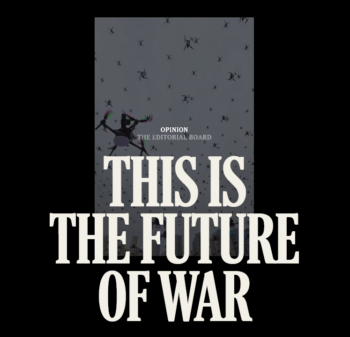
Faced with the prospect of “swarms of robotic aircraft that work in unison to find and kill targets without any human oversight, the New York Times‘ response (12/9/25) is that “the Pentagon must embrace technological change.”
Another area where the New York Times wants the US military to spend more money is autonomous weapons systems.
The Times (12/9/25) wrote that “China is testing how to fly drones in sync. Soon such swarms could hunt and kill on their own.” To counter this “growing threat,” the US “must simultaneously win the race to build autonomous weapons and lead the world in controlling them.” To do so, “Congress needs to expand funding for research and development into technologies with military applications” and Trump needs to “bring private industry into the mission.”
The Times wrote that they “join the United Nations secretary general and the International Committee of the Red Cross in their call for a new treaty to be concluded by 2026 on autonomous weapons systems.” The editors then say the treaty should include
limits on the types of targets, such as outlawing their use in situations where civilians or civilian objects are present; and requirements for human-machine interaction, notably to ensure effective human supervision, and timely intervention and deactivation.
But that’s far short of what the secretary general and the Red Cross recommend: a ban on all autonomous weapons used to attack humans. This humanitarian goal doesn’t square with the Times‘ enthusiasm for the US to “win the race to build autonomous weapons,” even if it says it also wants to “win the race to control them.”
Then again, there’s nothing about the Times‘ editorial series that suggests any honest consideration of humanitarian concerns—just adding another notch on its belt of warmongering on behalf of the State.
By Drew Favakeh