
A few stories about centibillionaires — men whose net worth exceeds $100 billion — and their role in our society:
· In 2022 Elon Musk, the richest man in the world, purchased Twitter. Since then he has turned the platform into a racist cesspool, overrun by literal Nazis.
· Last year Skydance Media, run by David Ellison — the son of Larry Ellison, the world’s 6th richest man — acquired Paramount, which includes CBS. The new management put Bari Weiss, a conservative pundit with no relevant experience, in charge of CBS News. The network that once featured Edward R. Murrow has been going downhill ever since. On Tuesday night CBS management, responding to an obviously partisan demand from the Trump-appointed head of the FCC, prevented Stephen Colbert from running an interview with Democratic Senate candidate James Talarico.
· Paramount is now trying to acquire Warner Brothers, which would give the Ellisons control of CNN.
· Jeff Bezos, the world’s 5th richest man, bought the Washington Post in 2013. He followed a hands-off approach for a decade, but in 2024 he began heavily intervening, preventing an endorsement of Kamala Harris, then requiring that the opinion section focus on “personal liberties and free markets.” He has now gutted the newsroom, leaving the paper that brought down Richard Nixon a shell of its former self.
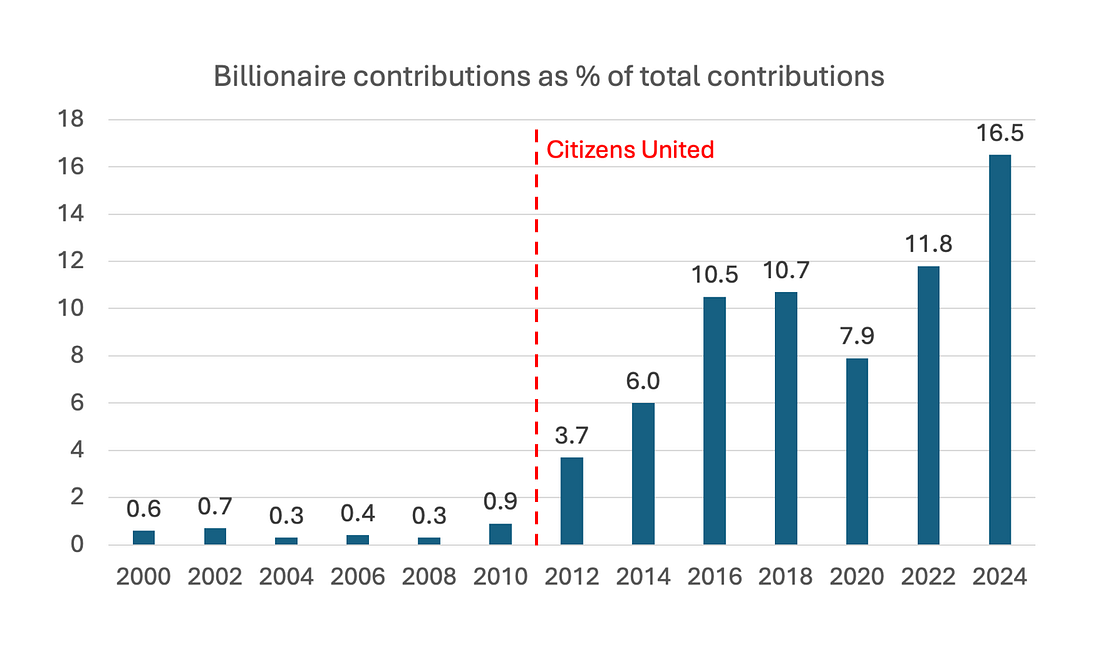
Furthermore, standard measures of political spending show an explosion of billionaire money seeking to influence American elections. Since the Roberts Supreme Court’s “Citizens United” ruling the percentage of total contributions accounted for by billionaire money has skyrocketed:
 |
Source: Americans for Tax Fairness
For those who need a refresher, Citizens United was a 2010 ruling by a narrow majority on the Supreme Court that effectively removed all restrictions on political spending by wealthy individuals and corporations. Such spending must be undertaken by nominally independent organizations, but in practice so-called Super PACs (political action committees) coordinate closely with candidates and parties. The result of the ruling, which you can see in the chart, was an explosion of political spending by billionaires as well as industry lobbying groups. Citizens United is what enabled both Elon Musk and the crypto industry to play huge roles in the 2024 election.
Some of the rise in billionaire spending can be explained by growth in the number of billionaires — but not much. The number of U.S. billionaires rose 85 percent between 2010 and 2023, from 404 to 748. But billionaires’ share of political contributions rose by 1700 percent.
In short, we are in the midst of an unprecedented power grab by America’s oligarchs. This power grab is arguably the most important fact about contemporary U.S. politics. In many ways MAGA is just a symptom.
What lies behind this power grab? An extraordinary concentration of wealth at the very top.
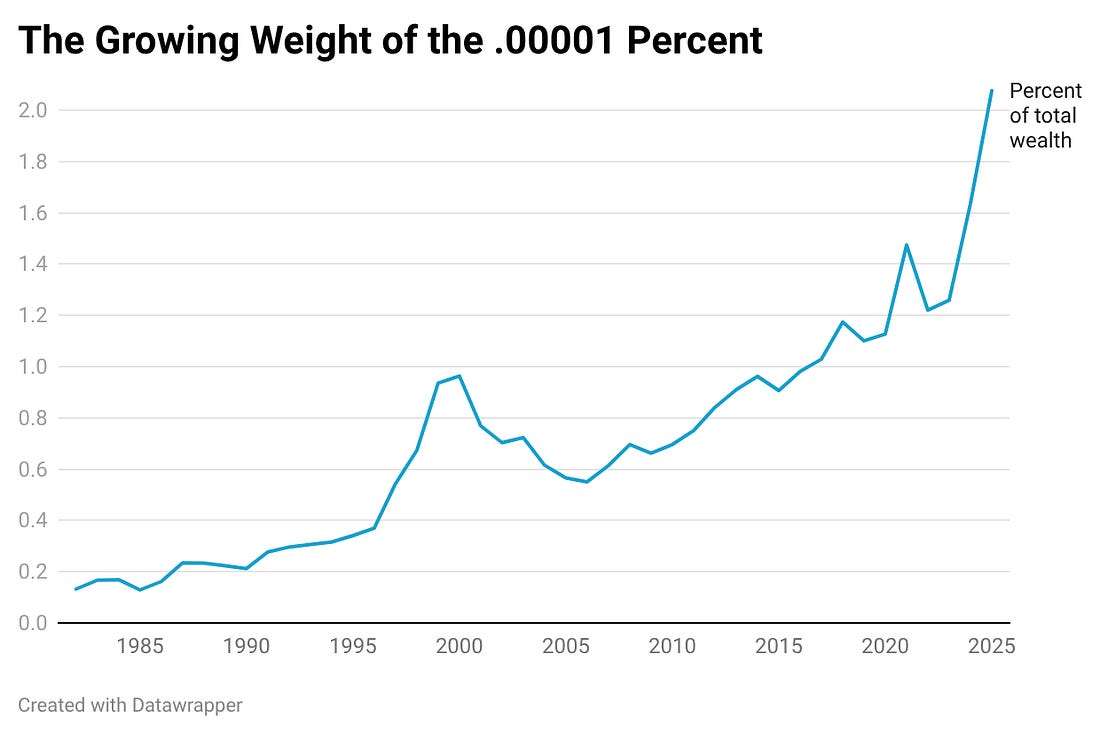
Last month I interviewed Gabriel Zucman, one of the world’s leading experts on wealth inequality (among other things.) Zucman has been producing charts on wealth at the very top — the 0.00001 percent, which currently means 19 people. He shared his latest data with me; it looks like this:
 |
Source: Gabriel Zucman
Wealth in America is now more concentrated in a few hands than it was during the Gilded Age of the late 19th and early 20th century. Money has always been a potent source of political influence, so this vast increase in concentrated wealth at the top inevitably translates into increased power.
However, after Citizens United America experienced an increase in oligarchic power far surpassing even what one might have expected given soaring wealth at the top. At this point it’s clear that we have experienced a fundamental change in the way our society works. Everything that is downstream of the American political system – federal and state governments, the courts, regulatory power, economic policy, health policy, media independence – and of course democracy itself – is under extreme threat from the tidal wave of billionaire influence.
Let me offer three reasons surging wealth at the top has caused a lurch away from democracy.
The first reason is a bit wonkish, but here goes: Political scientists and economists have long argued that highly concentrated interest groups are more politically effective than diffuse groups, an argument that goes back to Mancur Olson’s classic 1965 book The Logic of Collective Action.
Here’s a hypothetical example: Suppose that spending $1 billion on political influence would enrich a plutocrat by 1 percent of their wealth. Someone with “only” $30 billion in assets wouldn’t find this spending worth it: $1 billion in outlays produces only $300 million in capital gains – a loss of 70%. But someone with $300 billion in assets would gain $3 billion by spending $1 billion on political influence – a profit of 200%. In other words, because buying political influence is expensive, we would expect that the growing concentration of wealth within the plutocrat class will increase that class’s political spending and, therefore, its power.
Second, some forms of de facto political action – such as buying your own global media platform — can only be undertaken by men of truly immense personal wealth. Musk spent $44 billion to buy Twitter; 20 years earlier there were no individuals with that much money.
Finally, and crucially, billionaires haven’t just spent money to influence policy. They have also spent money to change the rules in ways that make money more powerful. Years of plutocratic investment in institutions from the Heritage Foundation to the Federalist Society prepared the ground for the Supreme Court’s Citizens United decision, which then opened the floodgates for vastly increased plutocratic influence.
Something comparably transformative has happened in the past year. Billionaires didn’t just help Donald Trump regain the White House, they helped create new de facto ground rules under which he can use his office for personal enrichment — which hugely expands the influence of those with the means to make him richer.
What are the ultra-wealthy doing with their vastly increased power? They are, of course, twisting policy in ways that will make them even richer, at the expense of everyone else. Anyone who imagines that the unthinkably rich aren’t greedy, because they can already afford to buy whatever they want, doesn’t understand human nature.
That said, even billionaires care about more than their own personal wealth. Unfortunately, their non-monetary goals are often worse than their greed.
Put it this way: Elon Musk hasn’t turned X, the former Twitter, into a platform promoting white supremacy and a safe space for Nazis as part of a strategy to enlarge his fortune. He has done it because it serves his personal agenda and reflects his values.
Today’s post is more about understanding where we are than about a call to action. Still, the obvious question is what can be done in the face of billionaires gone wild. The answer, clearly, is that any project to save American democracy must include a push to reduce the extreme concentration of wealth at the top.
We know that this can be done, because it has been done. In his famous Madison Garden speech of 1936 FDR declared war on “Government by organized money,” and he won that war. Progressive taxation and mass unionization drastically reduced the wealth and even more drastically diminished the power of big money.
To say that a comparable project is impossible today is to say that democracy can’t be saved. And I’m not willing to accept that. Are you?
By Paul Krugman Feb 18