
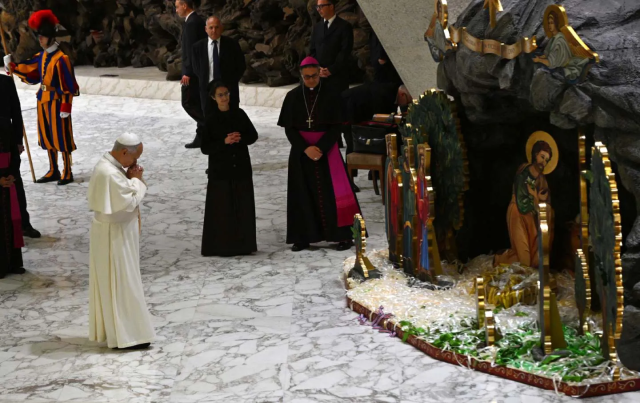
Pope Leo XIV stands in front of a Christmas nativity scene at Paul-VI hall in the Vatican on December 15, 2025. (Andreas Solaro / AFP via Getty Images)
As John Fugelsang, who runs the risk of becoming this era’s ablest political commentator, reminds us, “The Christmas economy depends on people buying possessions to celebrate the birthday of the man who renounced possessions.”
The author of this year’s best-selling objection to the abuses of religion and politics by right-wing Christian nationalists, Separation of Church and Hate: A Sane Person’s Guide to Taking Back the Bible from Fundamentalists, Fascists, and Flock-Fleecing Frauds, Fugelsang is a decent and good-humored fellow who has no desire to snow on our Christmas fun. He simply wants to remind us of biblical entreaties that tend to be lost on right-wing zealots who claim—as President Donald Trump has—that “Christianity is under tremendous siege” by liberal do-gooders.
“Jesus consistently sided with the underdogs, not the privileged and powerful,” writes Fugelsang. “Broad-minded, tolerant, and way too inclusive for the ultraconservatives of his day, the Nazarene modeled generosity and selflessness, and told his followers to share their resources and prioritize the well-being of other people over personal gain.”
Fugelsang further reminds us:
Jesus stood up to…the authoritarians among then religious leaders, drunk on their own eminence.
The wealthy, worshiping their own stature and possessions while denying the suffering of the poor.
The capitalists in the temple, greedily exploiting poor believers.
The imperial government of Rome, whose hunger for power led to its own collapse.
Those who imagine that this is too militant an interpretation of the gospels might consider the Gospel of Matthew, with its charge: “For I was an hungred, and ye gave me meat: I was thirsty and ye gave me drink: I was a stranger, and ye took me in:”
Or they might turn to the messages of Pope Leo XIV, who has carried forward the work of his predecessor Pope Francis, by asserting the importance of the Catholic Church’s “preferential option for the poor.” Leo wrote in his first apostolic exhortation, “God has a special place in his heart for those who are discriminated against and oppressed, and he asks us, his church, to make a decisive and radical choice in favor of the weakest.”
The bluntness with which the new pope has challenged the excesses of capitalism has drawn global comment—not all of it favorable. The pope has argued:
A concrete commitment to the poor must also be accompanied by a change in mentality that can have an impact at the cultural level. In fact, the illusion of happiness derived from a comfortable life pushes many people towards a vision of life centered on the accumulation of wealth and social success at all costs, even at the expense of others and by taking advantage of unjust social ideals and political-economic systems that favor the strongest. Thus, in a world where the poor are increasingly numerous, we paradoxically see the growth of a wealthy elite, living in a bubble of comfort and luxury, almost in another world compared to ordinary people. This means that a culture still persists—sometimes well disguised—that discards others without even realizing it and tolerates with indifference that millions of people die of hunger or survive in conditions unfit for human beings.
In September, Leo issued an exhortation to Christians on love for the poor. The document builds upon the writings of Francis, who died in April 2025 at age 88 and who also decried the excesses of capitalism with references to how “this economy kills.”
That is bold language, but it is also an honest assessment, as was Francis’s 2024 notation: “It is often precisely the wealthiest who oppose the realization of social justice or integral ecology out of sheer greed.”
In this season of light and charity, we have every reason to hope for the renewal of those instincts that Abraham Lincoln identified as “the better angels of our nature.” To do so, we must recognize the urgency of Pope Francis’s warning that “as long as the problems of the poor are not radically resolved by rejecting the absolute autonomy of markets and financial speculation and by attacking the structural causes of inequality, no solution will be found for the world’s problems or, for that matter, to any problems.” When he repeated this observation shortly before his passing, Francis observed, “I know it bothers [people when I say that], but it is the truth.”
by John Nichols