
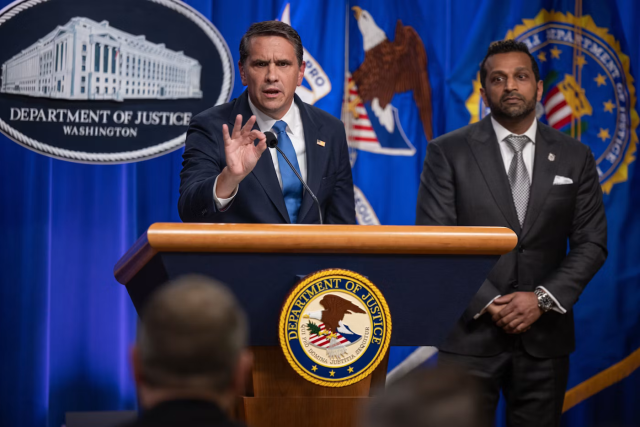
Blanche’s claims to the media are indicative of how the government’s narrative about the case has taken prominence over the legal process. In June, for instance, the Department of Justice sent a superseding indictment to the media before it was filed in federal court. SPLC’s lawyer Abbe Lowell told CBS News that sharing the indictment first with the press was “another example of the government’s troubling and unusual handling of this case.” In a later filing, the government said that “media members erroneously received the draft document.” It all only underscored the fact that what the government said in public showed its intentions more clearly than anything written in the court filings.
Groups that the SPLC placed on its Hate Map greeted the indictment eagerly, as an opportunity to turn public scrutiny back on a group that has long monitored them. Some are going further. At a hearing before the House Judiciary Committee earlier this month, a senior staffer at the Alliance Defending Freedom, a Southern Poverty Law Center–designated hate group, testified that his group, contrary to the SPLC’s characterization, is actually “mainstream.” Ryan Bangert, senior vice president for strategic initiatives as well as an adviser to the president of Alliance Defending Freedom, did not dispute that his organization had done what had warranted the SPLC’s designation: roll back the rights of LGBTQ+ people by way of social stigma and the law. It is an agenda evident in ADF’s interventions at the Supreme Court, such as its 2003 brief arguing in favor of laws criminalizing sodomy and in the words of its founder, who in 2012 described the group’s mission as a “battle” against “the homosexual legal agenda.”
The Alliance Defending Freedom’s legal agenda is hardly mainstream. It wasn’t mainstream in 2003, either, when 74 percent of adults surveyed at the time supported overturning sodomy laws, including 70 percent of those adults who described their political views as “conservative.” But ADF has worked overtime in the years since to remake the courts and the country to serve its Christian nationalist enterprise. (Sometimes, as it did in arguing to overturn the landmark abortion rights case Roe v. Wade, it succeeded.) But in this moment, when the Trump administration has marshaled the Justice Department to serve as the president’s enforcers, ADF may get to have it both ways: casting itself as an innocent victim of hatred for Christian conservatives and recasting the whole idea of “hate groups” as a variety of fraud. It also appears, based on a new filing last week in the federal case against the Southern Poverty Law Center, that Alliance Defending Freedom may have played a more direct role in the FBI’s recent investigation into the SPLC than was previously known.
The Christian right’s grievances against SPLC go beyond the Hate Map. When ADF’s Bangert testified before the house committee in June, he not only positioned his group as a purported victim of SPLC, but he also called on Congress to “reach beyond the indictment,” to take “critical steps toward dismantling” SPLC’s work, which he called a “shadow censorship regime” that had “tarred mainstream conservative organization as ‘hate groups.’” The examples of SPLC’s “censorship regime” were thin and beside the point. Bangert was jumping onto the government’s attempt to unmake SPLC.
Bangert himself has worked for state attorneys general who supported ADF’s mission, such as former Missouri Attorney General Josh Hawley (whose wife, Erin Hawley, works for ADF, arguing its failed attempt to ban medication abortion via telehealth in 2024). He also worked for Texas Attorney General Ken Paxton (whom Bangert later testified against in his 2023 impeachment trial). He knew what he was doing when he repeated the indictment’s allegation that SPLC had been “funding the racist groups they claimed to fight,” mischaracterizing payments made to informants inside those groups for tips that informed SPLC’s research and publications, and which they also shared with law enforcement. But Bangert quickly pivoted to what he called the “broader story” behind those “shocking allegations.” That’s the story, he said, of “how the SPLC tarred mainstream conservative organizations as hate groups.”
For ADF, it’s not just about refuting the “hate group” label but about casting doubt on the idea that opposition to LGBTQ+ rights could constitute hate. “We’ve been on the SPLC’s hate map since 2016, which is odd given that we reject racism,” Bangert also testified. Given that ADF has been listed for more than a decade, one might think he was familiar with the actual reasons why. “The SPLC lists ADF as a hate group because it has supported the idea that being LGBTQ+ should be a crime in the U.S. and abroad and believes that it is OK to put LGBTQ+ people in prison for engaging in consensual sex,” a 2020 story on the SPLC website begins. “ADF has played a role in the passage of religious exemption laws that lead to discrimination against LGBTQ+ people,” it goes on. “ADF is not only attempting to erase transgender people through its litigation and policy work but by deliberately misgendering them in media and on its website.”
For ADF to acknowledge the reason SPLC designated the group as it did, however, would require ADF to acknowledge that queer and trans people have civil rights, which ADF is dedicated to eroding. It is extremely disingenuous for ADF to pretend that SPLC only labels racist groups as hate groups, but the pretending is strategic: ADF appears to allow the claim that there are “real” hate groups, if only to state that it is not one.
Now Alliance Defending Freedom has appeared in the SPLC case by name—in documents the government had to hand over. A new filing from the Southern Poverty Law Center made these part of the court record. They point out that a prior investigation into SPLC, opened under Trump’s first administration, continued into the Biden administration and then was dropped. “The investigation sat closed for approximately four years,” the filing states. “It was suddenly reopened during the Trump Administration at least as early as September 2025. The question before the Court is why.” A letter to Stephen Miller, produced by the government in discovery, could provide an answer.
That letter, which appears to have been sent in August 2025, complains that SPLC, a “biased” and “politicized” organization “unmoored from its original mission,” has “begun placing traditional value and faith-based organizations” on its Hate Map, such as “Alliance Defending Freedom” and “Moms for Liberty.” It goes on to claim that “the SPLC places many groups on its ‘Hate Map’ as a smear tactic solely because they disagree with its radical leftwing ideology.” (They may as well have called it a “homosexual agenda.”)
The Miller letter was signed by the head of Alliance Defending Freedom, Kristen Waggoner, as well as Tina Descovich of Moms for Liberty, Turning Point USA’s Charlie Kirk, Christian pseudohistorian David Barton, reactionary conspiracy theorist James Lindsay, and the founder of Gays Against Groomers, an anti-trans group that has operated in the vein of Libs of TikTok. Parts of the groups’ letter to Miller appear lightly paraphrased in another document the government turned over: a redacted FBI incident report dated October 24, 2025, not long after the killing of Charlie Kirk and Trump’s directives to investigate the left over alleged “political violence.” As SPLC put it, the FBI incident report reads like a “rehashing” of the letter sent to Stephen Miller by these groups, some of which appear on the Hate List and were the main ones to complain about it. If groups like ADF protesting their appearance on the Hate Map is what prompted the FBI to reopen an investigation, SPLC contends, then the case wasn’t really about the financial crimes the government alleges. Rather, what provoked the investigation, it appears, was speech that these groups find objectionable.
If that is true, then the case against the Southern Poverty Law Center was at bottom motivated by Christian nationalist groups that want to punish SPLC for accurately describing their agendas. Also, notably, it was SPLC that exposed, based on scores of leaked emails, Stephen Miller’s links with white nationalists, pushing a shared anti-immigrant agenda that dates back to Trump’s first administration. A Department of Justice spokesperson told HuffPo that Miller “had nothing to do with FBI-Mobile’s investigation of the SPLC.” However, the spokesperson also said that the Miller letter “was provided by one of the signatory groups in the initial stages of an investigation of potential criminal law violations committed by the SPLC.” They did not say which group.
We may be hearing more about how this case came about soon, thanks to a whistleblower. The whistleblower’s allegations have not yet been made public, but they were described in an April 30 letter that Representatives Jamie Raskin and Mary Gay Scanlon sent to Aakash Singh, associate deputy attorney general. The congressmembers received reports that Singh “ordered the U.S. Attorney’s Office for the Middle District of Alabama to rush through the indictment of the SPLC despite serious concerns about the strength of the case,” their letter states. Singh had also previously instructed the leaders of each U.S. Attorney’s Office that the president is their “chief client.”
It was perhaps with a bit of authority, then, that at the June House Judiciary hearing where ADF’s Ryan Bangert testified, Representative Raskin called the prosecution of SPLC “a tissue of lies, that will join the pantheon of debunked, fraudulent prosecutions that DOJ has been excoriated for by dozens of judges across the land.” He added, “I predict it will not be long before another federal judge casts this obscene prosecution to the winds.”
If an investigation into the case itself results, we may hear more from Stephen Miller and from the groups on the Hate Map. But we may never learn whether an anti-LGBTQ group—whose founder said of its mission that it aimed to stop “the homosexual agenda,” and which argues major cases before the Supreme Court, sometimes with a sitting senator’s wife making the arguments—also has the influence to wield the Department of Justice against its political opponents. Perhaps ADF is simply fortunate enough to share some enemies with the “chief client” of the Justice Department: the president.
Melissa Gira Grant is a staff writer at The New Republic and the author of Playing the Whore: The Work of Sex Work.