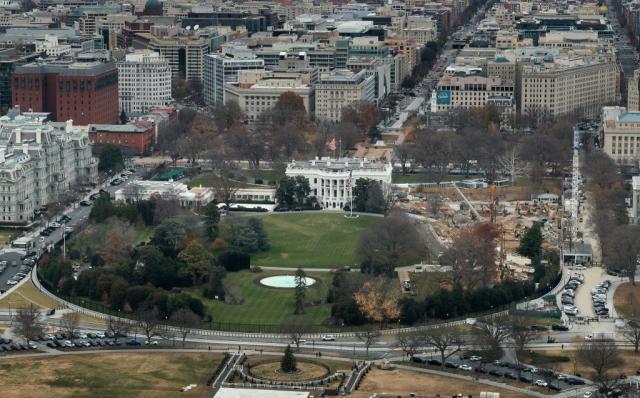
Eight days before the White House announced plans to build a 90,000-square-foot ballroom for state dinners and special events, President Donald Trump launched his AI Action Plan, a sweeping effort with more than 90 federal policy actions to accelerate artificial intelligence development across the U.S. government and American businesses.
The plan included executive orders aimed at easing permitting for massive data centers, expanding federal support for AI exports and reducing regulatory barriers for a tech industry racing to scale.
When Trump publicly announced the project on July 31, 2025, he said the ballroom would be funded entirely by private donations, including his own, and pegged the cost at $200 million. He has since doubled that estimate to $400 million and disclosed the names of 37 private donors backing the project. Major technology and AI firms make up roughly a quarter of those reported donors, which include cloud giants such as Amazon, Microsoft and Google; data and analytics contractors like Palantir and Booz Allen; and consumer tech companies such as Apple and Meta. A smaller number of defense contractors, including Lockheed Martin, and cryptocurrency companies such as Coinbase and Ripple also appear on the list. AI chipmaker Nvidia, which is not on the White House list, has also donated, according to CEO Jensen Huang, and Alphabet, Google’s parent company, contributed $22 million toward construction of the ballroom as part of a settlement after YouTube banned Trump following the Jan. 6, 2021, storming of the Capitol.
A review of federal spending shows that several of the ballroom donors — including Microsoft, Palantir, and Amazon Web Services — receive billions in federal contracts. Google’s public sector arm claimed it signed a $200 million contract last year. These companies also rank among the top spenders on lobbying, with Meta, Amazon and Alphabet reporting $19.8 million, $14 million and $12.3 million, respectively, during the first three quarters of 2025. Recent OpenSecrets reporting found that the number of lobbyists for AI and data center companies has surged alongside the construction of new facilities, including a seven-fold increase at OpenAI and dozens of new hires at Meta.
Trump hosted a private dinner at the White House on Oct. 15 for the nearly 130 donors and company representatives who donated to the Trust for the National Mall, the nonprofit managing Trump’s ballroom project. Some ethics experts warn that the White House’s unprecedented reliance on private funding could give donors undue influence over the president, particularly over policies that directly affect their businesses, including on artificial intelligence.
Donors stand to gain from AI executive orders
Several of these ballroom donors — including Alphabet, Amazon, Microsoft, Nvidia and Palantir — are major tech companies that stand to benefit from the AI Action Plan, and some were involved in shaping the plan itself: In February 2025, the White House’s Office of Science and Technology Policy solicited input from industry and academia, with Alphabet, Microsoft and Palantir among those submitting recommendations before the March 15 deadline.
The Trump administration has framed its AI Action Plan as necessary to compete with China and secure U.S. dominance in artificial intelligence, arguing that the country that builds the largest AI ecosystem — spanning chips, data centers, energy capacity, and deployment infrastructure — will set global standards and capture long-term economic and strategic advantages. At the core of that strategy is computing power. Training frontier AI models requires massive amounts of computing power, and the administration has argued that environmental permitting rules and other regulatory barriers make building the necessary AI infrastructure slow and difficult — a bottleneck that could determine whether American companies lead or lag in the next era of AI.
Following the release of the AI Action Plan, Trump signed three executive orders aimed at implementing those priorities. Several of the companies positioned to benefit from the executive orders are also among the donors to the ballroom project.
The first executive order, “Promoting the Export of the American AI Technology Stack,” focuses on expanding the global reach of U.S.-origin AI systems as a counterweight to China’s growing influence abroad. Rather than promoting individual technologies, the order provides a framework for exporting bundled, “full-stack” AI systems abroad that combine computing hardware, software, data, cybersecurity and applications into integrated offerings. Companies such as Microsoft and Amazon Web Services — both ballroom donors — are among those positioned to benefit, according to Janet Egan, deputy director of the Technology and National Security Program at the Center for a New American Security, who explained that hyperscale cloud providers with large data centers already operate integrated platforms at global scale.
The second executive order, “Accelerating Federal Permitting of Data Center Infrastructure,” is designed to fast-track federal approvals for large AI, tech and defense projects on federal land. Experts say it reduces regulatory hurdles under the National Environmental Policy Act, the Clean Water Act and other environmental laws, giving well-capitalized technology and defense firms a faster path to build massive infrastructure. According to Jacob Malcom, a former director of the Office of Policy Analysis for the Department of the Interior, the order is going to benefit large tech and AI firms “immensely” by making it easier for them to bypass public review.
The third executive order, “Preventing Woke AI in the Federal Government,” is among the administration’s latest moves targeting diversity, equity and inclusion efforts. The order directs federal agencies to buy only AI systems that meet new “unbiased” standards that prioritize factual accuracy and avoid what the administration describes as ideological content. The policy applies only to federal contracts — not private companies.
Ballroom donors praise AI Action Plan
Several major ballroom donors have publicly praised the AI Action Plan. Microsoft thanked the president “for his strong leadership on AI,” with the company’s vice chair, Brad Smith, calling the AI Action Plan “the golden opportunity for American AI.”
Other major tech donors echoed this support. Amazon highlighted its $156 billion investment in expanding data center infrastructure and supply chains, noting that the AI Action Plan aligns with its efforts to maintain global AI leadership. Meta called the plan a “landmark arrangement” and praised the private industry’s collaboration with the federal government. Palantir, a software company that deploys AI, called the plan “much-needed” in a blog post and announced that “Palantir is proud that the substance of so many of our recommendations to the White House helped shape the final plan.”
Although tech firms and software companies are among the most visible beneficiaries, other major firms and ballroom donors, including Lockheed Martin, stand to gain as well. As a major defense and aerospace company, Lockheed packages AI technology from Meta, Nvidia and Oracle into a turnkey system that agencies can use immediately, claiming the Astris AI for Government platform will advance America’s AI Action Plan.
Conflict-of-interest and access concerns
Ethics experts warn that when companies with major business before the federal government donate large sums to a president’s favored project, it can create the appearance they are buying access and influence.
“There is a concern that when companies give to a favored project of the president, they’re going to get more favorable treatment in decisions about grants, contracts and procurement, regulation, enforcement or non-enforcement of existing rules, or about the writing of rules that would affect how these companies do their business,” said Richard Briffault, a professor at Columbia Law School who formerly served as chairman of the New York City Conflicts of Interest Board. “Without any evidence or allegations of quid pro quo of any specific details, there’s this general sense that you’re kind of buying favorable treatment.”
Briffault said firms that rely on federal contracts or regulatory approvals may feel pressure to donate when other companies are contributing, out of concern they could otherwise be sidelined or disadvantaged in future government decisions.
Unlike federal campaign contributions, which must be publicly disclosed, donations to a 501(c)(3) public charity such as the Trust for the National Mall are tax-deductible and do not have to be publicly reported. In the 2021 case Americans for Prosperity Foundation v. Bonta, the Supreme Court ruled that California could not force charities to disclose major donors’ identities, holding that the requirement violated donors’ First Amendment right to freedom of association.
The White House has released a list of donors but has not disclosed the amount of each contribution. Because there is no legal requirement to disclose donors, the public is dependent on what the White House chooses to reveal, even as reporting shows some contributors — like Nvidia and Alphabet — were omitted from Trump’s list. That gap allows donors to potentially wield influence without public scrutiny.
“We have nowhere near the transparency that you have with political campaigns,” said Richard Painter, a professor at the University of Minnesota Law School who served as chief ethics lawyer in the White House Counsel’s Office under President George W. Bush. “It’s a huge problem. It’s very hard to get this information, and yet this is another way to buy influence.”
In an email statement, White House spokesman Davis Ingle told OpenSecrets: “The same critics who are alleging fake conflicts of interests would also complain if American taxpayers were footing the bill for these long-overdue renovations. The donors for the White House ballroom project represent a wide array of great American companies and generous individuals, all of whom are contributing to make the People’s House better for generations to come.”
Painter rejected the White House’s argument that private funding saves taxpayer money, arguing that although the ballroom may not rely on public funds upfront, donors are giving huge sums of money because they expect something in return — and that any preferential treatment in contracts or policy decisions could ultimately cost taxpayers far more.
Unprecedented private funding
Painter also raised concerns that Trump’s failure to seek congressional approval for the ballroom violates the intent of the Antideficiency Act, which restricts government agencies from accepting private funds without explicit authorization from Congress. He said the statute was designed to prevent people from donating to the government in order to buy influence.
In December, the National Trust for Historic Preservation, a congressionally chartered nonprofit, sued Trump, the National Park Service, the Interior Department and the General Services Administration, alleging the administration violated federal law by beginning construction without required approvals from Congress and federal planning agencies, including the National Capital Planning Commission and the Commission of Fine Arts.
Historically, Congress has been tasked with funding and maintaining the White House, from major renovation, such as the complete structural reconstruction under President Harry S. Truman, to routine upkeep and furnishings.
Private donations aren’t entirely without precedent: In the 1980s, first lady Nancy Reagan sought $200,000 and received over $800,000 in private funds for a refurbishment of the White House living quarters, spending about $730,000, according to the White House Historical Association. But private donations have typically been limited to smaller items, like chairs, commemorative ornaments and other small furnishings, said Virginia Canter, chief counsel for ethics and anticorruption at the Democracy Defenders Fund.
”There’s never been anything on the scale of this $400 million ballroom,” Canter said. “This is far beyond anything like that. This is a vanity project that serves no legitimate public interest.”
Painter said he never saw anything comparable during his time in the Bush administration and warned the ballroom could become a permanent hub for political fundraising, making it easier for private companies to buy influence.
He said the ballroom poses “a threat to democracy,” arguing it would turn proximity to the president into a political reward.
“It is selling access to the White House — to his work, his residence and his office — mostly to campaign donors,” he said.